Bathtubs and Big Dreams

How a bold experiment at the 1999 Edmonton International Fringe Theatre Festival became the hit play The Drowning Girls, and why playwright Beth Graham believes in the power of taking creative risks.
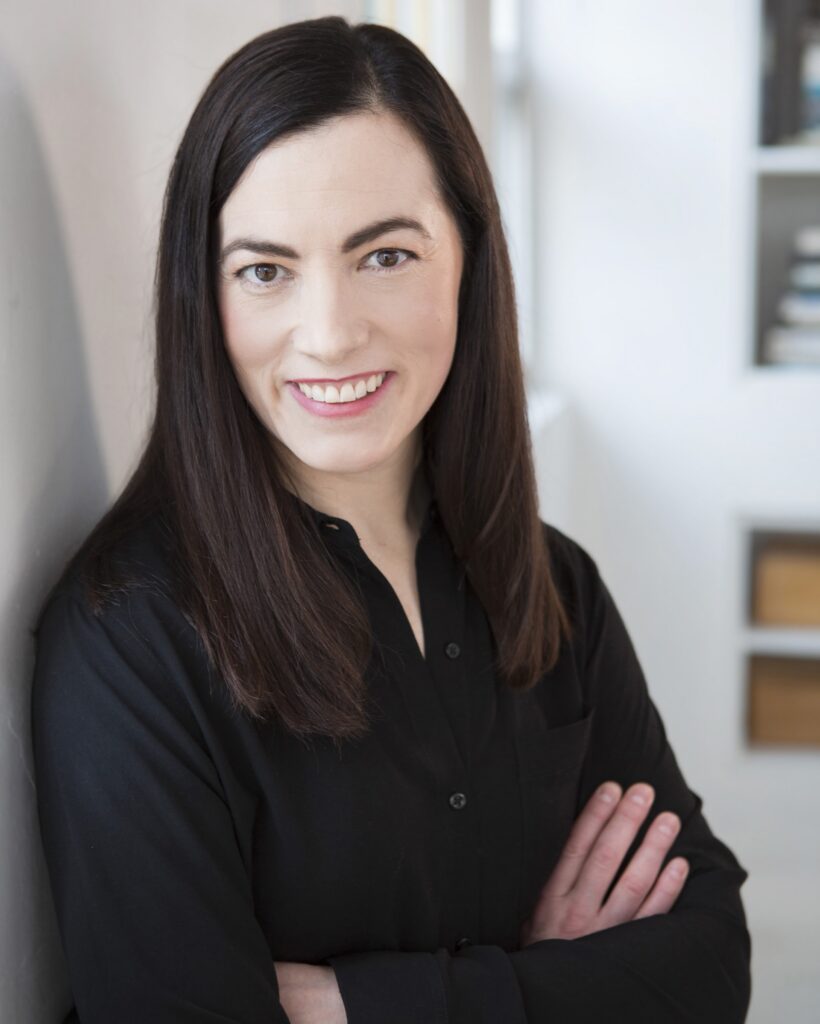
co-creator, The Drowning Girls.
Photography by David Spowart
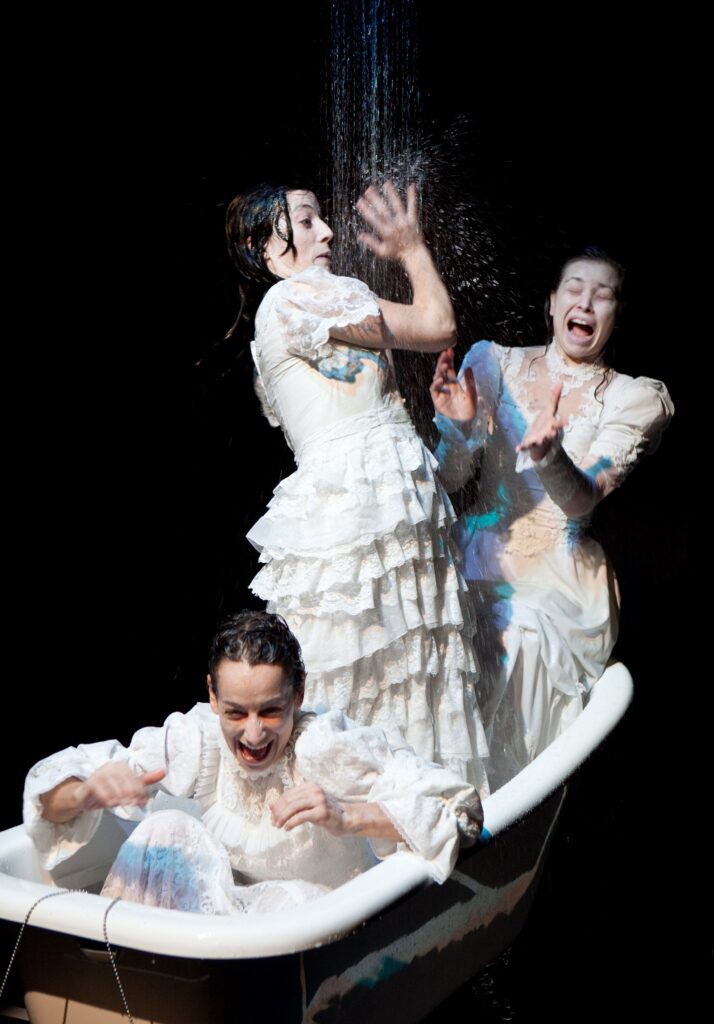
Two women in a bathtub.
That was the initial image that inspired The Drowning Girls, a play created by Beth Graham, Daniela Vlaskalic, and Charlie Tomlinson. The show made its debut at the 1999 Edmonton International Fringe Theatre Festival.
They had an image, an empty rehearsal hall, and a deadline. What they didn’t have yet was a script.
“We didn’t know the story yet. We just had an image, and we knew we had a deadline, which was the Fringe Festival,” Beth recalls. “In our naivete, at least Daniela and I – I don’t know what Charlie was thinking – but we’re like: yeah, we can write a play in a month!”
And so, they got to work.
Their creative laboratory? Room 3-125 at the University of Alberta. A room that might stir up a few memories for Edmonton theatre Artists who spent their formative years within its walls.
After a week of experimenting (and a little panicking), they discovered a Scotland Yard case that would become the foundation of The Drowning Girls: the true story of three women murdered by the same man in early 20th-century England.
“Oh my God, that’s our story! That’s our story! That’s our story!” Beth remembers exclaiming.
The three collaborators worked around the clock, writing, improvising, and discovering the play together. By the time Festival rolled around, they had a show.
Was it any good? They weren’t entirely sure.
Beth remembers Daniela pacing backstage before their very first performance, asking: “Is this any good?!”
“I looked at her and I said: ‘I don’t think so!’ And then we just went on stage.”
Fortunately, the uncertainty was part of the process.
“I think that is part of the joy of the Fringe,” Beth explains. “You’re putting up something pretty raw – certainly things that have been worked on – but it feels very experimental, and there was a rawness to it, that was exciting.”
And there was water. Lots of water.
The original production featured a borrowed cast-iron clawfoot bathtub, supported by wooden blocks where two of its feet were missing. Every performance meant filling the tub with buckets of water, then hauling it out after the show through the theatre’s garage door to empty it into the parking lot.
Beth fondly remembers the technicians who helped make it happen.
“Without George and Perry, we never would have been able to lift that thing,” she laughs.
It was an ambitious, messy, and wonderfully Fringe beginning.
Nine years after its Fringe debut, The Drowning Girls returned in a new form.
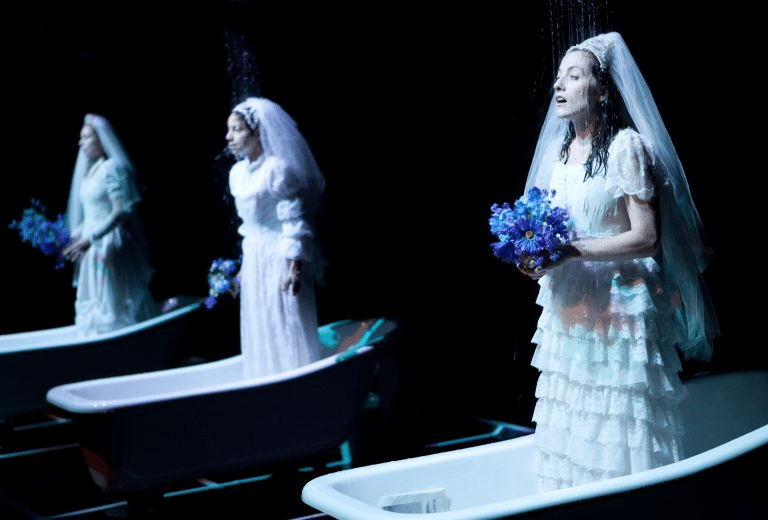
The original two-person production had always felt like it was missing someone. After all, the story was about three women.
“We talked about this third person. She should be here with us,” Beth explains. “She’s here. She wants us to write her. She’s knocking on the bathtub.”
In 2008, the creators revisited the work, expanding it into the three-person version that premiered at Alberta Theatre Projects’ playRites Festival.
Since then, The Drowning Girls has taken on a life of its own, with more than 200 productions across Canada and around the world!
Between 2009 and 2011, the play toured to Tarragon Theatre in Toronto, Royal Manitoba Theatre Centre in Winnipeg, Persephone Theatre in Saskatoon, Belfry Theatre in Victoria, and Gateway Theatre in Richmond.
It’s also become a favourite among high schools and universities, including being particularly popular in Texas. Go figure!
The play has even crossed language barriers, with a Turkish-language production staged in Istanbul between 2021 and 2026.
For Beth, that journey might never have happened without the opportunity to experiment at Fringe.
“It allowed us to discover the story, and discover ourselves in the work,” she says.
And it wasn’t just about learning how to write and perform. Fringe taught them how to produce, promote, collaborate, and build a show from the ground up.
“We self-produced that tour,” Beth recalls of the show’s travels in 2010 and 2011. “I don’t know if we would have thought we had the capability without Fringe.”
It’s a powerful reminder that a Fringe production is so much more than a performance. It’s an opportunity for Artists to develop skills, discover their creative voices, find collaborators and new audiences, and build the confidence to take their work somewhere new.
You never really know where a Fringe show might lead.
co-creator, The Drowning Girls
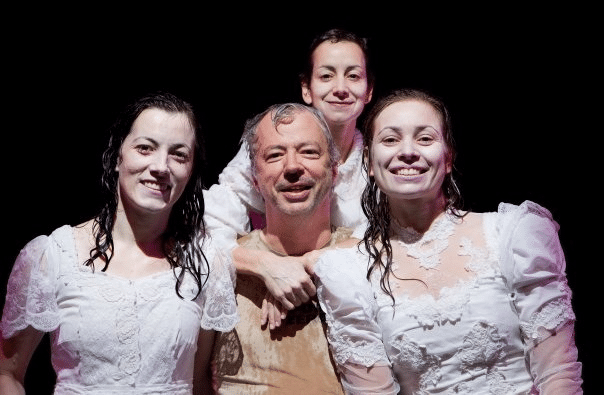
Now, more than 27 years after its original Fringe debut, The Drowning Girls is returning to Fringe Theatre.
From March 23 – April 3, 2027, The Redheads & Queers Collective will present a new production as part of the Fringe Theatre Season.
For Beth, seeing a new generation of Edmonton Artists take on the play is something special.
“In a word, amazing,” she says.
While Beth isn’t directly involved in this production, she has worked with the creative team members in different capacities over the years and is thrilled to see them collaborating.
“I think of them as colleagues,” she says, reflecting on the Artists she’s worked alongside and learned from.
It’s a philosophy that echoes her own early experience creating The Drowning Girls with Charlie and Daniela. Artists at different stages of their careers coming together to make something new.
“You never know where stuff’s going to come from,” Beth explains. “It’s also inspiring because you’re like: ‘oh yeah, these new Artists are excited!’ I love to see what other folks are going to bring to it.”
And seeing the play return to Fringe, where it all began?
“I think it’s like the perfect full circle moment.”
The upcoming production is particularly meaningful because it’s supported by the Westbury Family Fringe Theatre Award, which provides independent Artists with resources and opportunities to bring their creative visions to life.
“Because it’s such hard work, and you need support. Theatre costs money,” Beth explains. “It’s just so important to give a platform and a space and a chance to have production value, so you can get it past idea form.”
“It’s gonna sound cheesy, but this kind of support makes a dream a reality.”
Twenty-seven years ago, Beth, Daniela, and Charlie needed an opportunity to try something new. Today, a new group of Artists is getting an opportunity to bring their own interpretation of that work to the stage.
And the creative cycle continues.
For Beth, Fringe has always been about more than the shows themselves.
It’s about community.
“I really think it was how I met my community. In a lot of ways, was Fringe.”
From those early days in university rehearsal rooms to the conversations in Beer Tents and chance encounters on Festival Grounds, Fringe helped Beth find her people.
It’s a place where Artists at every stage of their careers can connect, collaborate, and surprise one another. Where audiences are willing to take a chance on something they’ve never seen before. And where an idea that seems a little strange, over-ambitious, or impossible might just become something extraordinary.
“Fringe is full of surprises. Like artistic surprises from people,” Beth says. “This conversation makes me want to do it again.”
But those opportunities don’t happen on their own.
When asked what Edmonton’s theatre community might lose without an accessible place for Artists to experiment, take risks, and find audiences, Beth doesn’t hesitate.
“I almost feel it’s like we’d lose a generation of creators.”
Without opportunities to create new work, Artists might never discover what they’re capable of. And audiences might never experience the stories those Artists have to tell.
That’s why Beth believes donating to Fringe is an investment in something much bigger than any one production.
“They have to be able to have that platform to experiment, learn about themselves, learn about the work, succeed, fail, all of that to just make the art form better.”
And when you make a charitable donation to Fringe Theatre, you’re helping create those opportunities.
“You’re investing in potential. It’s community building potential,” Beth explains. “You never know where something’s going to go, or what’s going to happen to it. So why not feed that?”
After all, nobody knew what would become of two women in a bathtub back in 1999.
And that’s exactly the point.
Your donation helps make room for the next big idea.
The next daring experiment. The next creative collaboration. The next Artist discovering what they’re capable of.
As Beth puts it: “Give what you can; it adds up.”
Give to Fringe Theatre today. Help sustain a place where Artists can take risks, find community, and turn big dreams into and exciting reality.
We’ve built this movement on duct tape and dreams. If every person who bought a ticket last year donated just $5 a month, every month, Fringe Theatre would become immediately sustainable.
This is our moment. Be part of the movement.