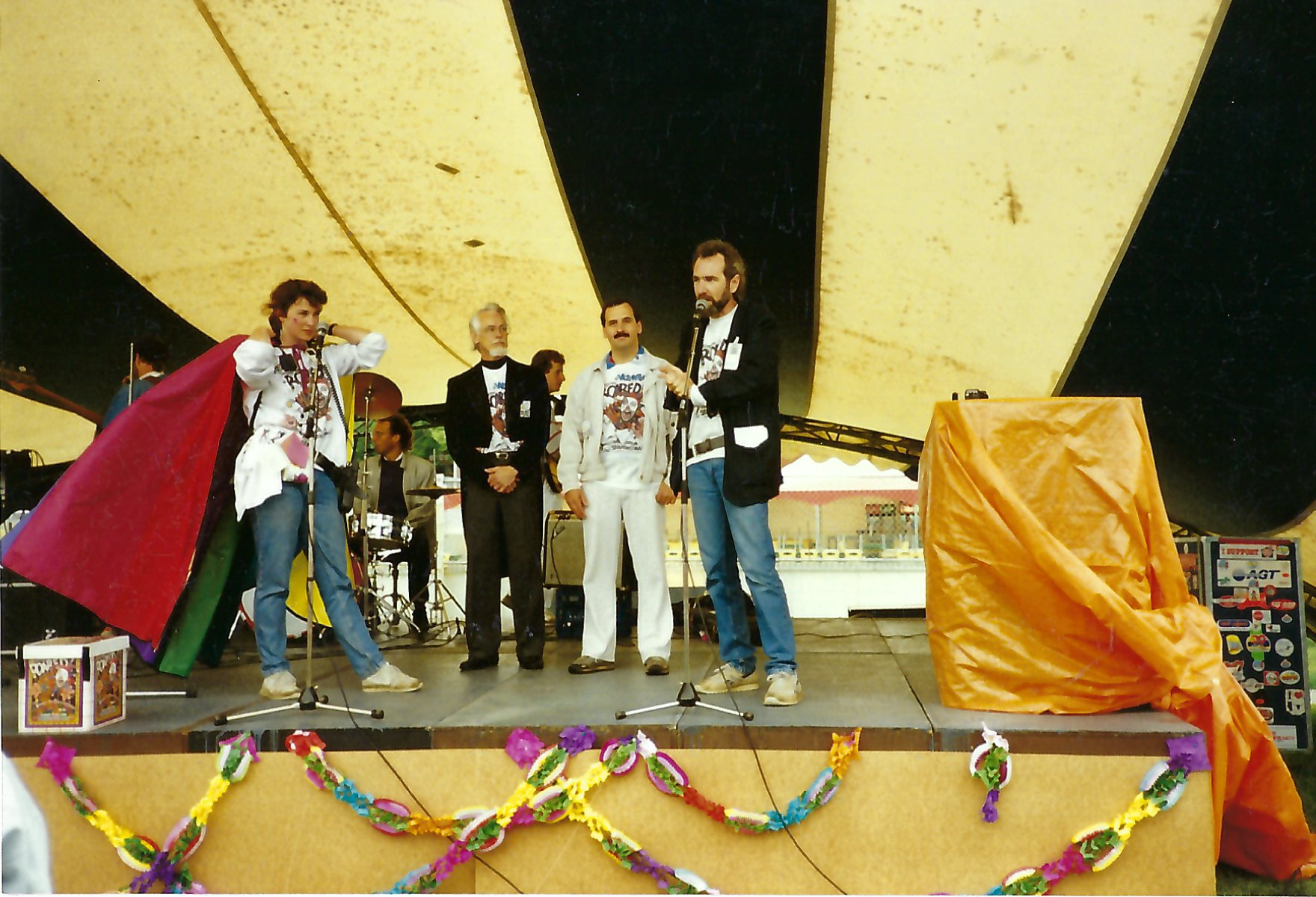
Honouring Brian Paisley

This article first appeared in The Fringers’ Almanac in 2022. We share it again now in honour of Brian “Father Fringe” Paisley, whose bold belief that anyone can be an Artist and everyone has a story to tell helped transform Edmonton and sparked a movement that continues to inspire communities across North America.
Brian’s family has shared that he is currently facing serious health challenges. We offer this story as a small celebration of his remarkable life and legacy, and as a reminder that the stories we tell and the communities we build have a way of carrying us through difficult times. Brian’s family has created a GoFundMe page where they are sharing updates and information for those who would like to learn more.
It started small (but not that small), and weird, and off-the-cuff 40 summers ago. The one-off that wasn't.
Four decades of fringing later, in the prairie town that invented that summertime verb–and still the Edmonton Fringe has managed to pull off a surprising, improvised, against-the-odds coup de théâtre in 2021.
And as it did a lifetime ago in the very different world of 1982, when no one saw a Fringe coming, the oldest and biggest Fringe on the continent, surprised everyone at 40, and celebrated a big birthday … by actually happening. Smaller yes (but not that small), and weird, and live, in the middle of a pandemic, after 18 months of flat, isolating, devastation for performing artists and their audiences.
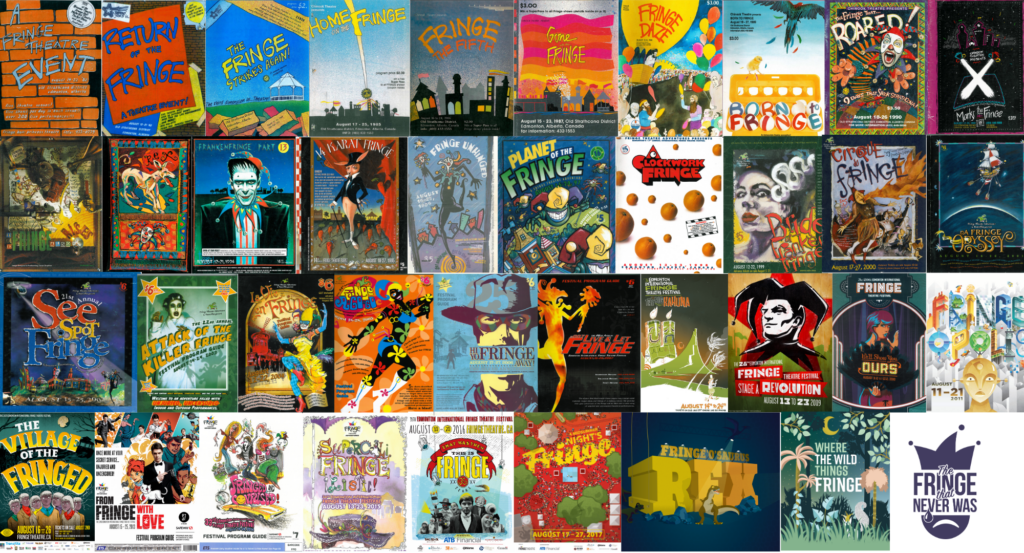
The Fringers' Almanac
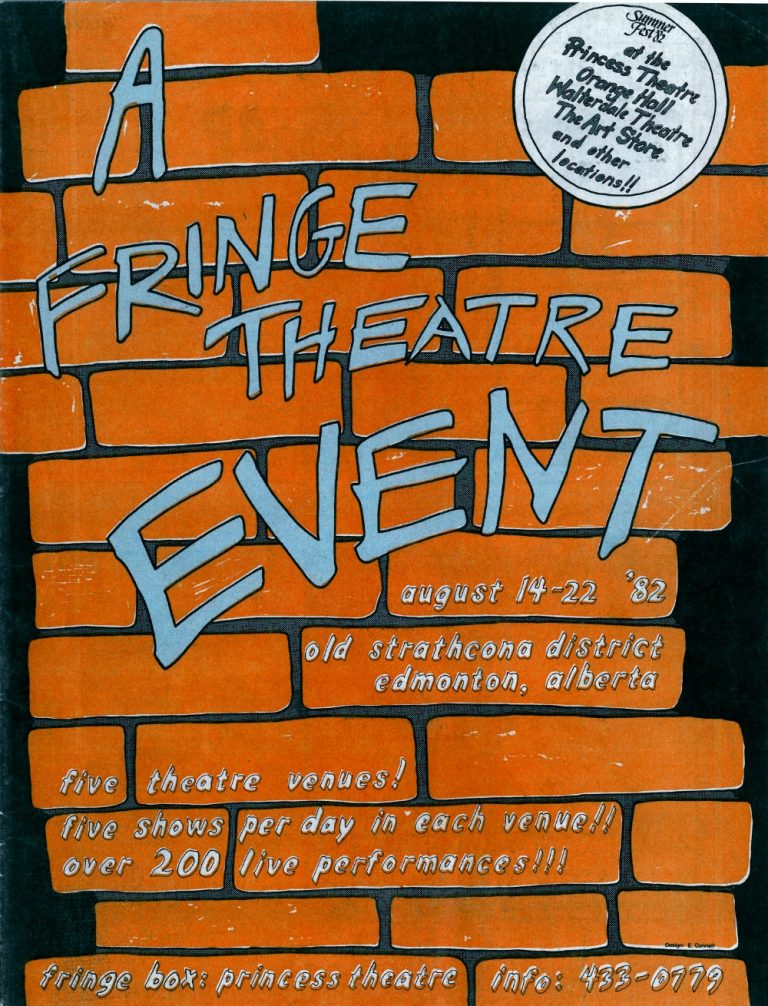
True, the breezy “why not?” spirit of that crazy but essentially simple invitation to artists–come to Old Strathcona and do a show, see if anyone shows up, collect the gate or suck up the loss–became a complicated, high-stakes “how?” question in the summer of 2021. The improbable way a birthday bash became a coming-out party for live theatre in this strangest of years, is tuned to the frequency of the Fringe’s earliest off-key siren call. It even reclaimed “A Fringe Theatre Event,” the mysterious moniker of 1982.

Our Fringe has always been an improviser. It started with a modest cue. And year after year, it’s scrambled to shore up the unexpected (and its own non-interventionist personality) against epic chaos, with some sort of ad hoc infrastructure and wacky stop-gap fixes as it grew exponentially, and regularly burst its buttons.
It grew, pell-mell and word-of-mouth, into a size XL monster inside an historic ‘hood that was a funky collection of derelict warehouses, abandoned storefronts, and defunct beaneries 40 years ago. Old Strathcona improvised, too, into the liveliest part of town.
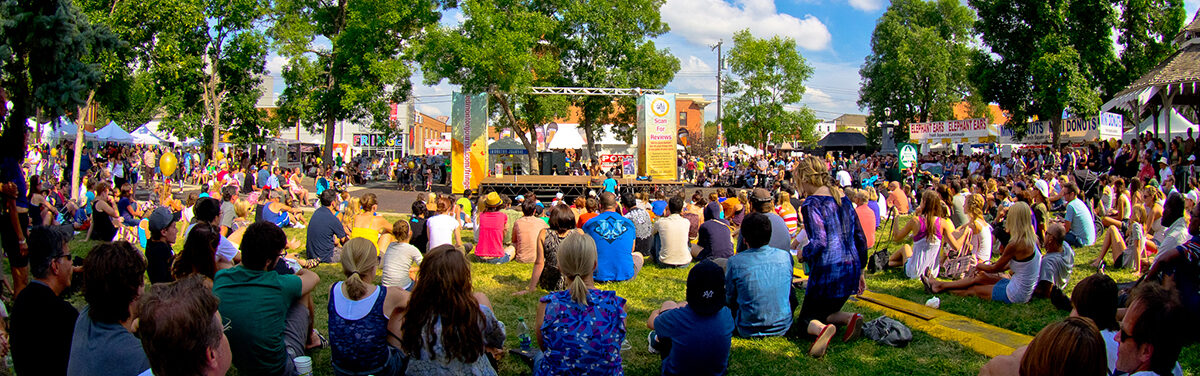
Fringe history is a tangible demo of “being in the moment,” as theatre people like to describe spontaneity. A Festival that can dub itself Together We Fringe: A Fringe Theatre Event in the late-pandemic August of 2021, when “together” is the most provocative and challenging of words, a bona fide deal-breaker, is an improv champ. And in the last 40 years the Fringe has made improvisers of us all.
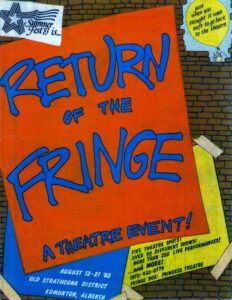 The Return of the Fringe, edition #2 in 1983, was my own Fringe debut, as a theatre writer. My first assignment, half an hour or so into my new job at the Edmonton Journal, was “go to Old Strathcona, find out about this Fringe thing that’s happening, whatever it is, and don’t come back for a week.” Improv time. Nothing about my academic specialty, Shakespearean stages and the late Shakespeare romances, really prepared me for an immersive “tour” called Shit And Death Are Everywhere, or Buck Duke’s Wild Sex Show, or The Day My Bum Caught Fire. Or really anything by theatre companies with names like Crybaby Killer Theatre or Brain Dead Productions.
Preconceptions wouldn’t cut it at the Fringe, an indispensable lesson for a critic. Sometimes the shows were bright ideas barely sketched out, sometimes valiant attempts. Some were more finished productions, or fabulous flame-outs. The Fringe audience, myself included, learned to enjoy theatre at every stage of development, to suss out potential under ragtag circumstances, to appreciate the impressive way actors commit to raw material that might be anywhere on the spectrum from hare-brained to promising, via ill-fated. The classics dressed down. They stood on their heads; they danced, wore red clown noses or body bags, joined hands with comedy troupes, handed over whole volumes to a single busy performer.
 The particular genius of the Fringe is that, like improv, it has a natural propensity for battering the barriers between “art” and the world. Its gambit? Find out what theatre is like when you ask artists, “So, what is it YOU want to do?” instead of telling them. And what it’s like is … unpredictable. It doesn’t always work out, but it’s exciting.
It changes the balance of power. And it attracts an audience that might not sign up for the formal (and pricier) theatre experience. It’s fun, and that’s the right word, to be part of an audience that doesn’t know how The Trojan Women or Macbeth will turn out, but wants to find out. And it’s fun to come out of a Fringe show and hear the question “what the **!* just happened there?” Quite often you’re the one asking. A range of answers are available in the beer tent.
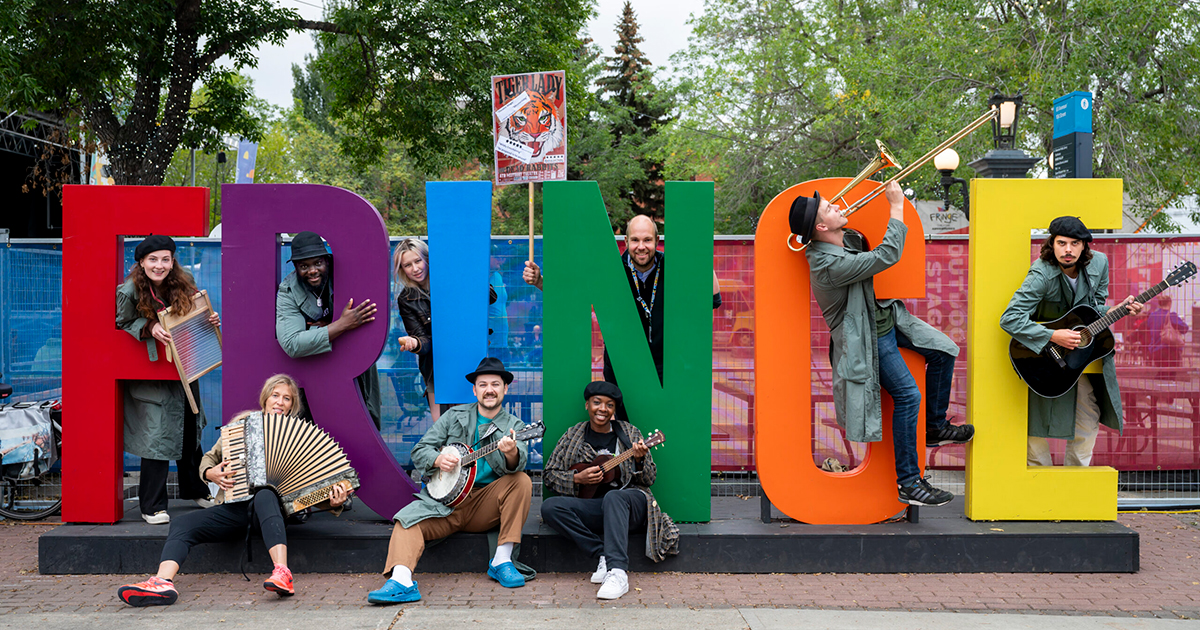
Uncensored and unjuried, the Fringe has improvised four decades of meet-and-greets between artists and audiences in makeshift theatres where “stage” might be just a figure of speech–at two in the afternoon or eleven at night–to see what will happen. Sometimes the people love what they see; sometimes they don’t. In the free-wheeling free enterprise marketplace that’s the Fringe, supply and demand almost never quite jibe. It gives the Fringe, at its Fringe-iest, a distinctively off-kilter energy. It’s the natural home of the sleeper hit.
Fringe founder Brian Paisley’s instinct that the artistic mandate to not have an artistic mandate would be an artist magnet has been borne out for 40 years now. No rules in a low-stakes world means no reason for fledgling talents, renegades and theatre veterans alike not to give their most idiosyncratic, wayward, commercially unviable ideas a shot. Teatro La Quindicina and Shadow Theatre were both born in that proposition. And by embracing unpredictability, it captured the imagination of audiences. They doubled in size every year for the first five, and grew and grew after that.
It changed a city–its entertainment demeanour, its sense of a party, its bedtime, its profile across the country, the continent, and beyond.
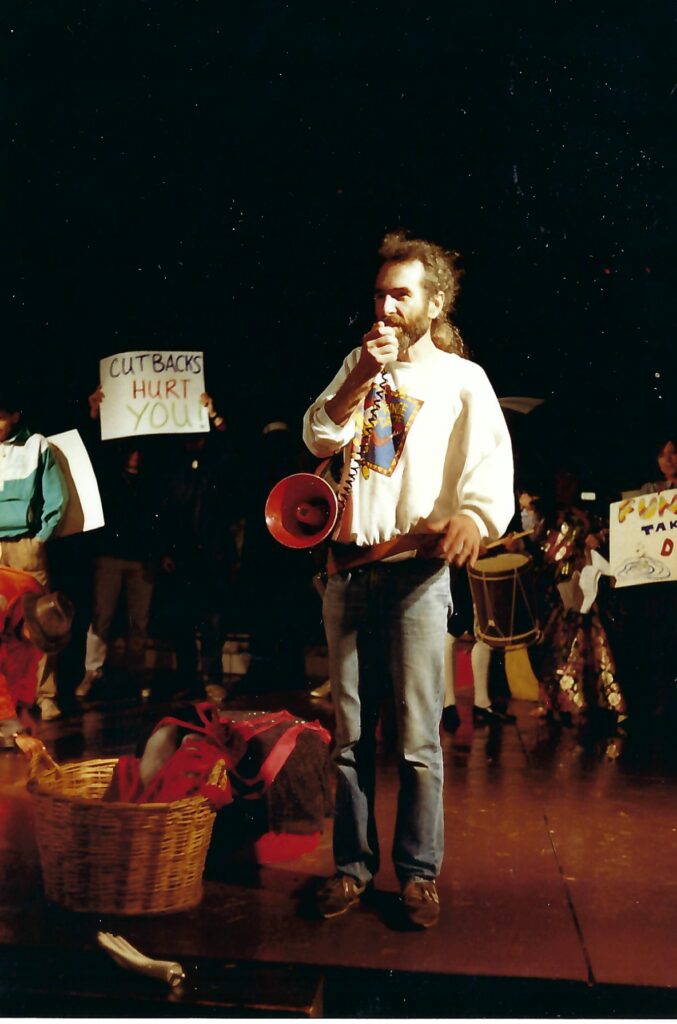
Founder of the Edmonton International Fringe Theatre Festival
the artistic mandate to not have an artistic
mandate would be an artist magnet has
been borne out for 40 years now.
From the start Edmonton’s best idea, and its most influential cultural export, was rooted here. The Edmonton of 1982 was a hinterland city with a disproportionate number of actors, directors, playwrights, theatre companies– who all vanished for the summer off-season the moment the subscription season was over.
The Fringe’s low-risk prompt, Do What You Want (and see what the audience thinks), intrigued them. It kept our artists here, improvising. It inspired actors to start making their own theatre (or theatre companies), directors to try their hand at playwriting …
And as it turned out, the world started coming to them.
Even at the debut edition, for reasons no one has ever been able to ascertain, a troupe of Brazilian puppeteers showed up to deconstruct the Adam and Eve story. That mysteriously improvised global drift of artists, from Kiev or Kampala, Melbourne or Moscow, would continue; it would inspire unexpected artistic collaborations and change the unsalted civic flavour palette.
And, based on the Edmonton model that was adapted from the enormous Fringe in Edinburgh, there would soon be Fringes in other places, a circuit across the country and the border, Ottawa to Orlando, Saskatoon to San Diego.
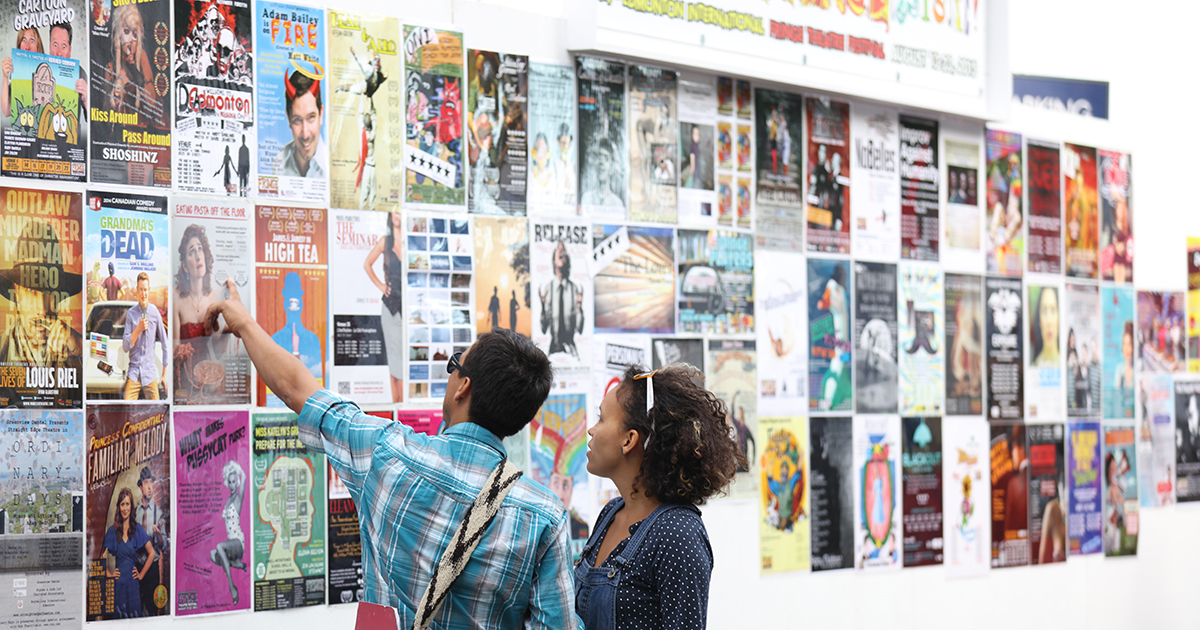
It changed the way theatre got made in this country. For one thing, since Fringe theatre gravitated to improvised venues where theatrical ingenuity trounced budget, it landed a character part in prying Canadian theatre loose from the prairie naturalism where it had been entrenched for decades. It was a match-maker for multi-disciplinary talents. And in a part of the world loathe, until quite recently, to direct mainstream resources toward developing new theatre, it’s had a role as Canada’s new play workshop.
What four decades of fringing have taught us, though, isn’t really to root around for the next Broadway musical buried somewhere in the Fringe lineup, though, hey, it could happen.
And, true, it’s hatched the phenomenon of the “Fringe show,” unrisky, calculated, fashioned by those who’ve sniffed out a commercial angle from the huge audiences. But at its truest, the Fringe spirit has bonded us to live theatre in a grassroots way. It’s given us a chance to see what theatre artists get up to, how their creative minds tick, how theatrical ideas get brainstormed and improvised onto the stage.
What we’ve seen has surprised us; it’s made live lively, and agile. What a pandemic has taught us is that we’ll be fringing for the next 40 summers, too.